BitTorrent [the company] has recently released an interesting new sync tool [link]. It is a peer to peer tool that allows users to sync files over multiple machines over the internet.
This seemed a very interesting development until somebody found something interesting.
Dear Bittorrent,
After digging around in some wireshark logs of my btsync setup I found
that btsync calls home to a server named: www.usyncapp.com.
I believe this is to gather statistics on which version is running where
on what platform and so on. Especially important during the testing
period I guess. Is the software still going to be doing this when it is
final? And what info are you saving for how long and what purposes?
Then somebody claiming to be from BitTorrent admitted this -
Hi, Christian here from BitTorrent.
"Sync was built for secure sharing. While we have general statistics
about the app, we don’t have any access to private information.
The client reports back anonymous usage statistics in the same way our
other clients do. Sync uses this call to check if there’s a new build
available. This call also contains some anonymous statistics that allow
us to understand how Sync performs, and how it’s being used; data
transferred directly, through relay, size of folders, and number of
files synced.
This is the only information we collect, and we left it open
intentionally – so that people could see the data we’re collecting. That
way, it can be easily verified that we don’t have access to any private
information. Read more here: http://forum.bittorrent.com/topic/17002-btsync-calling-home/ [bittorrent.com] "
Some users are annoyed that BitTorrent did not admit this up front and warn that people should use this tool at their own risk. There has been muttering about spyware and rootkits.
Eclectica
No man but a blockhead ever wrote but for money. Dr. Samuel Johnson
NSA guide to searching the web
The US National Security Agency has just put its 643 page guide to searching the web in the public domain. It can be downloaded as a PDF.
Link
Link
UN investigator says Syrian rebels used Sarin gas
In an interview with Swiss-Italian TV on Sunday, Ms Del Ponte, who
serves on the UN's Independent International Commission of Inquiry on Syria,
said: "Our investigators have been in neighbouring countries
interviewing victims, doctors and field hospitals.
"According to their report of last week, which I have seen, there are strong, concrete suspicions but not yet incontrovertible proof of the use of sarin gas, from the way the victims were treated."
Carla Del Ponte said testimony from victims and doctors had given rise to "strong, concrete suspicions but not yet incontrovertible proof" that the rebels had used Sarin.
This is all very disappointing for those who have been busy trying to push the USA and UK into war with Syria. It also raises the question as to who supplied the rebels with the gas and why they did it.
It was interesting to see how the British media treated the story.
The BBC web site put and kept the story on its front page but revised the story substantially over today in a obvious attempt to cast doubt on Ms Del Ponte's comments. The BBC has been accepting rebel statements as gospel and publishing them without any clear attempt to verify them. Proper journalistic standards have been abandoned when it comes to presenting the rebel case but all of a sudden the BBC's critical facilities have been restored when it comes to rubbishing an inconvenient truth. Was there a call from Number 10 to the state controlled media?
The Telegraph also had the story on its front page this morning. By the evening it had been cut and moved to an inside page and placed alongside a story about British tourists in Italy being overcharged for ice cream.
The Guardian web site never had the story at all. Not important enough for you, chaps?
Humbert Wolfe said
You cannot hope to bribe or twist, thank God! the British journalist.
But, seeing what the man will do unbribed, there's no occasion to.
Unfortunately, the first line is not true.
"According to their report of last week, which I have seen, there are strong, concrete suspicions but not yet incontrovertible proof of the use of sarin gas, from the way the victims were treated."
Carla Del Ponte said testimony from victims and doctors had given rise to "strong, concrete suspicions but not yet incontrovertible proof" that the rebels had used Sarin.
This is all very disappointing for those who have been busy trying to push the USA and UK into war with Syria. It also raises the question as to who supplied the rebels with the gas and why they did it.
It was interesting to see how the British media treated the story.
The BBC web site put and kept the story on its front page but revised the story substantially over today in a obvious attempt to cast doubt on Ms Del Ponte's comments. The BBC has been accepting rebel statements as gospel and publishing them without any clear attempt to verify them. Proper journalistic standards have been abandoned when it comes to presenting the rebel case but all of a sudden the BBC's critical facilities have been restored when it comes to rubbishing an inconvenient truth. Was there a call from Number 10 to the state controlled media?
The Telegraph also had the story on its front page this morning. By the evening it had been cut and moved to an inside page and placed alongside a story about British tourists in Italy being overcharged for ice cream.
The Guardian web site never had the story at all. Not important enough for you, chaps?
Humbert Wolfe said
You cannot hope to bribe or twist, thank God! the British journalist.
But, seeing what the man will do unbribed, there's no occasion to.
Unfortunately, the first line is not true.
Alternatives to Google's services
The Guardian has a handy list of alternatives to Google's services. Click here.
I already use DuckDuckGo as my search engine. It is a very acceptable alternative to Google.
I did not know about Nokia's maps but they seem to be as good, if not better, than Google Maps.
The Guardian mentions Tumblr as an alternative to Blogger. I have started using both Wordpress and Tumblr after it became clear that Blogger was on Google's kill list. Given the rate at which Google is closing its services it makes sense not to post anything to Blogger that you would be sorry to lose when it closes.
I already use DuckDuckGo as my search engine. It is a very acceptable alternative to Google.
I did not know about Nokia's maps but they seem to be as good, if not better, than Google Maps.
The Guardian mentions Tumblr as an alternative to Blogger. I have started using both Wordpress and Tumblr after it became clear that Blogger was on Google's kill list. Given the rate at which Google is closing its services it makes sense not to post anything to Blogger that you would be sorry to lose when it closes.
Jack Irish now on film
If you are a fan of Peter Temple's Jack Irish books you will want to know that the first two books [Black Tide and Bad Debts] have been filmed and are available on DVD from Amazon. Guy Pearce [Lieutenant Exley in LA Confidential] plays Jack.
They are very good. There are plans to film the other two books [White Dog and Dead Point] and Temple is said to be working on a fifth JI book.
Google Alerts has stopped working
The very useful Google Alerts has stopped working [yet again]. Is this another service Google is killing so that it can get its snout further into the trough?
The CIA's criminal stupidity
"In its zeal to identify bin Laden or his family, the CIA used a sham
hepatitis B vaccination project to collect DNA in the neighbourhood where
he was hiding. The effort apparently failed, but the violation of trust
threatens to set back global public health efforts by decades.
The deadly consequences have already begun. Villagers along the Pakistan-Afghanistan border chased off legitimate vaccine workers, accusing them of being spies. Taliban commanders banned polio vaccinations in parts of Pakistan, specifically citing the bin Laden ruse as justification. Then, last December, nine vaccine workers were murdered in Pakistan, eventually prompting the United Nations to withdraw its vaccination teams. Two months later gunmen killed 10 polio workers in Nigeria—a sign that the violence against vaccinators may be spreading."
Full Scientific American story here
The CIA scheme was grossly irresponsible. It has already lead to dozens of deaths amongst health workers. In the future it will kill or cripple thousands of unvaccinated children.
Presumably the scheme was thought up by some wannabe who didn't think or care about the consequences. He or she probably just wanted to earn some brownie points with their bosses.
Another reason for the USA to be ashamed.
The deadly consequences have already begun. Villagers along the Pakistan-Afghanistan border chased off legitimate vaccine workers, accusing them of being spies. Taliban commanders banned polio vaccinations in parts of Pakistan, specifically citing the bin Laden ruse as justification. Then, last December, nine vaccine workers were murdered in Pakistan, eventually prompting the United Nations to withdraw its vaccination teams. Two months later gunmen killed 10 polio workers in Nigeria—a sign that the violence against vaccinators may be spreading."
Full Scientific American story here
The CIA scheme was grossly irresponsible. It has already lead to dozens of deaths amongst health workers. In the future it will kill or cripple thousands of unvaccinated children.
Presumably the scheme was thought up by some wannabe who didn't think or care about the consequences. He or she probably just wanted to earn some brownie points with their bosses.
Another reason for the USA to be ashamed.
Syrian Sarin gas attack - an Israeli false flag operation?
See which of the following you believe.
1. The Syrian Government has used Sarin gas even though they know that this is exactly what their enemies want them to do to provide a pretext for military intervention.
2. No gas has been used. It is disinformation by parties unknown intended to provide a pretext for military intervention.
3. Gas has been used as part of an Israeli false flags operation to provide a pretext for military intervention.
I do not believe 1 but I can easily believe 2 or 3.
..........
See which of the following you believe.
After Iraqi and the WMD lies the UK government believes that
1. We are stupid enough to believe their latest set of lies.
1. We are not stupid enough to believe their latest set of lies.
I think they believe 1.
To see who Cameron and Hague want us to support read this article in Time about someone who has actually fought in the Civil War..
"Once he defected from the Syrian Army in early 2012, he quickly climbed the ranks of a well-regarded rebel brigade fighting near Homs. But he was blinded in one eye in the battle of Baba Amr and escaped to Lebanon for surgery.
When he returned to Syria a few months later, he was shocked by the levels of corruption and thievery within the ranks of his own brigade. The weapons he arranged to have smuggled over the border from Lebanon had been sold off for cash, and comrades who once winced at firing a gun now relished in the kill. Acts of battlefield barbarity had become commonplace. He saw corpses mutilated and watched opposition fighters steal from the populations they were supposed to be defending."
1. The Syrian Government has used Sarin gas even though they know that this is exactly what their enemies want them to do to provide a pretext for military intervention.
2. No gas has been used. It is disinformation by parties unknown intended to provide a pretext for military intervention.
3. Gas has been used as part of an Israeli false flags operation to provide a pretext for military intervention.
I do not believe 1 but I can easily believe 2 or 3.
..........
See which of the following you believe.
After Iraqi and the WMD lies the UK government believes that
1. We are stupid enough to believe their latest set of lies.
1. We are not stupid enough to believe their latest set of lies.
I think they believe 1.
To see who Cameron and Hague want us to support read this article in Time about someone who has actually fought in the Civil War..
"Once he defected from the Syrian Army in early 2012, he quickly climbed the ranks of a well-regarded rebel brigade fighting near Homs. But he was blinded in one eye in the battle of Baba Amr and escaped to Lebanon for surgery.
When he returned to Syria a few months later, he was shocked by the levels of corruption and thievery within the ranks of his own brigade. The weapons he arranged to have smuggled over the border from Lebanon had been sold off for cash, and comrades who once winced at firing a gun now relished in the kill. Acts of battlefield barbarity had become commonplace. He saw corpses mutilated and watched opposition fighters steal from the populations they were supposed to be defending."
Liberals kill Snoopers Charter.
The so called Snoopers Charter was an attempt by the UK police and secret police to set up a system spy on everything that we do online.
Kudos to Clegg and the Liberals for killing the proposal [Link]. I thought they had forgotten why some of us vote for them. Maybe they are getting back their identity.
The scheme was supposed to make us safer but was wildly disproportionate to any risk we face.
Not only would it have been a gross invasion of our privacy but it would have given far too much power to the UK's security apparatus. Knowledge is power and the Snoopers Charter would have given enormous power to the secret squirrels. From our mobile phone they would have known where we had been, who we had been with and who we had contacted. From our browsing they would have known what we read online and what we wrote. They would have spied on journalists and politicians and would soon have been able to issue them instructions. They would have acquired enormous political power.
The career of Edgar Hoover of the FBI is a lesson to all politicians of the risks of allowing the squirrels to know too much. Hoover used his files to blackmail politicians and defy Presidents. We don't want to create an Edgar Hoover in the UK.
If this paranoid just consider what Putin did before his present job. Consider that George Bush used to run the CIA.
BTW - In all the reporting on the Snoopers Charter I have not noticed any naming of the people behind the scheme. It was a shadowy body called the Joint Intelligence Committee. I am not sure why journalists have been so reluctant to identify this very dodgy group. They are the same people who want to set up secret courts so the public does not find out about the secret squirrel's misdeeds.
Kudos to Clegg and the Liberals for killing the proposal [Link]. I thought they had forgotten why some of us vote for them. Maybe they are getting back their identity.
The scheme was supposed to make us safer but was wildly disproportionate to any risk we face.
Not only would it have been a gross invasion of our privacy but it would have given far too much power to the UK's security apparatus. Knowledge is power and the Snoopers Charter would have given enormous power to the secret squirrels. From our mobile phone they would have known where we had been, who we had been with and who we had contacted. From our browsing they would have known what we read online and what we wrote. They would have spied on journalists and politicians and would soon have been able to issue them instructions. They would have acquired enormous political power.
The career of Edgar Hoover of the FBI is a lesson to all politicians of the risks of allowing the squirrels to know too much. Hoover used his files to blackmail politicians and defy Presidents. We don't want to create an Edgar Hoover in the UK.
If this paranoid just consider what Putin did before his present job. Consider that George Bush used to run the CIA.
BTW - In all the reporting on the Snoopers Charter I have not noticed any naming of the people behind the scheme. It was a shadowy body called the Joint Intelligence Committee. I am not sure why journalists have been so reluctant to identify this very dodgy group. They are the same people who want to set up secret courts so the public does not find out about the secret squirrel's misdeeds.
Sick of it - hysterical media coverage of Boston bombing
I am sick of the absurd media coverage of the Boston bombings, and it is a pity the President had to join in the hysteria. You would think somebody had set off a nuclear bomb. Don't the media numpties have any sense of proportion?
Meanwhile, a chemical plant explodes near Waco and nobody seems to care very much.
Another sign Blogger is marked for closure
" Blogger no longer offers any direct support — just a forum where users
can commiserate and try to answer each other's questions. No support email gets any response, and repeated posts on the forum
don't either. Many other reports can be found in the forums concerning
people who can't get any help from Support."
Link
Link
Which are the really dangerous drugs?
The Science and Technology Committee of the UK Parliament commissioned an assessment of legal and illegal stimulants using scientific evidence to determine which are the most harmful. In addition, they took evidence from expert witnesses. This was all done as part of a study of the use of scientific evidence in the UK government’s decision making. The Committee have published their findings.
In the UK class A drugs carry higher penalties than those in classes B and C. some drugs, including alcohol and tobacco, are unclassified and do not carry any legal penalties.

The scientific study assessed the drugs according to the following criteria.

They then produced this table.

I took this data and entered it in a spreadsheet to produce this chart. The higher the score the more harmful the drugs.

Red = a class A drug
Blue = a class B drug
Green = a class C drug
Yellow = an unclassified drug
If the study has classified the drugs correctly this suggest that both alcohol and tobacco should be class B drugs, LSD should be a class C drug rather than being in class A, and ecstasy should be unclassified. The current classification of ecstasy as a class A drug may seem strange given what is known of its effects. However, drug policy in the UK is largely made by the tabloid newspapers and the classification of ecstasy is largely a result of the tabloid frenzy over the Leah Betts case.
A chart based on such a reclassification might look like this -

That would be that the possession of alcohol or tobacco would carry a sentence of up to five years imprisonment [or a fine], and supply of either of these drugs would carry a sentence of up to fourteen years imprisonment [or a fine].
You could argue that drug policy should only concern itself with social harm since that represents the cost to society of drug use. The degree of physical harm or addiction inflicted by a drug might be considered solely a matter for the user, and no concern of society.
The next chart shows the reclassification of drugs based solely on social harm.

Alcohol has now become a class A drug, less harmful than heroin but more harmful than cocaine. Tobacco has become a class C drug [I suppose because of the secondary smoking effects].
In the UK class A drugs carry higher penalties than those in classes B and C. some drugs, including alcohol and tobacco, are unclassified and do not carry any legal penalties.

The scientific study assessed the drugs according to the following criteria.

They then produced this table.

I took this data and entered it in a spreadsheet to produce this chart. The higher the score the more harmful the drugs.

Red = a class A drug
Blue = a class B drug
Green = a class C drug
Yellow = an unclassified drug
If the study has classified the drugs correctly this suggest that both alcohol and tobacco should be class B drugs, LSD should be a class C drug rather than being in class A, and ecstasy should be unclassified. The current classification of ecstasy as a class A drug may seem strange given what is known of its effects. However, drug policy in the UK is largely made by the tabloid newspapers and the classification of ecstasy is largely a result of the tabloid frenzy over the Leah Betts case.
A chart based on such a reclassification might look like this -

That would be that the possession of alcohol or tobacco would carry a sentence of up to five years imprisonment [or a fine], and supply of either of these drugs would carry a sentence of up to fourteen years imprisonment [or a fine].
You could argue that drug policy should only concern itself with social harm since that represents the cost to society of drug use. The degree of physical harm or addiction inflicted by a drug might be considered solely a matter for the user, and no concern of society.
The next chart shows the reclassification of drugs based solely on social harm.

Alcohol has now become a class A drug, less harmful than heroin but more harmful than cocaine. Tobacco has become a class C drug [I suppose because of the secondary smoking effects].
Old map covers
All drawn by Ellis Martin for OS maps published in the 1920s. Click on the map tag for more examples.
'The 1920s and 30s saw the rise of the British tourist industry when, for the first time, ordinary working-class people had enough weekend leisure time to leave their smoky factory towns for a couple of days, and take to the country with its fresh, invigorating air.
It was the beginning of the cycling crazes and the hiking boom, and railway excursions, and - for those who could afford it - days out in the car.
All over the country, map-makers were producing maps of the most attractive areas, and walkers, cyclists and motorists were buying them in their millions. Fierce competition raged between these map-makers until the Ordnance Survey engaged an artist called ELLIS MARTIN to design eye-catching covers for its maps. From then on, the Ordnance Survey led the maket and Martin's superb period designs for OS map covers are now collectors' pieces.' J P Browne Map Cover Art
I like this finely drawn commercial art. This links to a post I did on cigarette cards.
'The 1920s and 30s saw the rise of the British tourist industry when, for the first time, ordinary working-class people had enough weekend leisure time to leave their smoky factory towns for a couple of days, and take to the country with its fresh, invigorating air.
It was the beginning of the cycling crazes and the hiking boom, and railway excursions, and - for those who could afford it - days out in the car.
All over the country, map-makers were producing maps of the most attractive areas, and walkers, cyclists and motorists were buying them in their millions. Fierce competition raged between these map-makers until the Ordnance Survey engaged an artist called ELLIS MARTIN to design eye-catching covers for its maps. From then on, the Ordnance Survey led the maket and Martin's superb period designs for OS map covers are now collectors' pieces.' J P Browne Map Cover Art
I like this finely drawn commercial art. This links to a post I did on cigarette cards.
Old map covers
All drawn by Ellis Martin, with the exception of the Liverpool map [Arthur Palmer] and the Peak District map [J C T Willis]. All drawn for maps published in the 1920s, with the exception of the Peak District map which was printed in 1936.
Click on the map tag for more examples.
How Israel fuelled a civil war
In the early 19602 a group of British mercenaries went out to the Yemen to fight in a civil war between Royalists and Republicans. The mercenaries were mainly former SAS. Their story is told in
They fought on the side of the Royalists. They were a very unsavoury bunch who were supported by the equally unsavoury Jordan and Saudi Arabia. Britain had an interest in protecting in base in Aden and connived at the mercenaries activities.The USA manoeuvred clumsily in the background.
The Republicans were supported by Egypt who sent troops and planes. Eventually, after much duplicity and bloodshed the Republicans won.
The Duff Hart-Davis book contains one interesting revelation.
Israel supplied arms to the Royalists. The Royalists didn't know that they were getting aid from Israel because it was funnelled through the British mercenaries. Israeli transport planes flew into a secret airfield in the mountains at night and unloaded guns and ammunition which the British then delivered to the Royalist groups. If the Royalists had known the source of their arms they would have been enraged.
Israel supplied the arms because they wanted to tie the Egyptians down in Yemen. The covert operation was successful. Egypt's commitment to the war is considered to have damaged its performance in the Six-Day War of June 1967. Egyptian military historians refer to the war in Yemen as their Vietnam.
Does this sound familiar? It might do because many people believe that Israel is busy trying to repeat the trick in Syria. Their aim being to weaken an enemy and also draw a bigger enemy, Iran, into the quagmire.
Britain and France want to supply arms to the rebels in Syria. Supposedly this is being done to alleviate human suffering and depose Assad. Critics see several problems with this scenario.
Assad is the leader of the Alawites. The war is not between a tyrant and the Syrian people but between the Sunni majority and the Alawites [and other religious minorities including Christians]. Defeating Assad will mean defeating the Alawites and will result in massive ethnic cleansing.
What is motivating Britain and France? Why their sudden interest in Syria? Why, if they want to alleviate human suffering, are they not putting all their money into helping refugees?
Supplying arms to the rebels will prolong the war, not shorten it. Iran cannot let the Syrian government be defeated for reasons I covered in this post. Russia does not want complete American hegemony in the Middle East. If Israel's proxies feed arms and men into Syria they will do the same and the war will grind on.
They fought on the side of the Royalists. They were a very unsavoury bunch who were supported by the equally unsavoury Jordan and Saudi Arabia. Britain had an interest in protecting in base in Aden and connived at the mercenaries activities.The USA manoeuvred clumsily in the background.
The Republicans were supported by Egypt who sent troops and planes. Eventually, after much duplicity and bloodshed the Republicans won.
The Duff Hart-Davis book contains one interesting revelation.
Israel supplied arms to the Royalists. The Royalists didn't know that they were getting aid from Israel because it was funnelled through the British mercenaries. Israeli transport planes flew into a secret airfield in the mountains at night and unloaded guns and ammunition which the British then delivered to the Royalist groups. If the Royalists had known the source of their arms they would have been enraged.
Israel supplied the arms because they wanted to tie the Egyptians down in Yemen. The covert operation was successful. Egypt's commitment to the war is considered to have damaged its performance in the Six-Day War of June 1967. Egyptian military historians refer to the war in Yemen as their Vietnam.
Does this sound familiar? It might do because many people believe that Israel is busy trying to repeat the trick in Syria. Their aim being to weaken an enemy and also draw a bigger enemy, Iran, into the quagmire.
Britain and France want to supply arms to the rebels in Syria. Supposedly this is being done to alleviate human suffering and depose Assad. Critics see several problems with this scenario.
Assad is the leader of the Alawites. The war is not between a tyrant and the Syrian people but between the Sunni majority and the Alawites [and other religious minorities including Christians]. Defeating Assad will mean defeating the Alawites and will result in massive ethnic cleansing.
What is motivating Britain and France? Why their sudden interest in Syria? Why, if they want to alleviate human suffering, are they not putting all their money into helping refugees?
Supplying arms to the rebels will prolong the war, not shorten it. Iran cannot let the Syrian government be defeated for reasons I covered in this post. Russia does not want complete American hegemony in the Middle East. If Israel's proxies feed arms and men into Syria they will do the same and the war will grind on.
Volvelles, Wheel Charts and Slide Charts
An alternative to Google Reader
Google Reader is closing on the 1st July.
I suggest Newsblur as your new feed reader. I have been using it for a while and would recommend it. Its mobile reader is not as good but in other respects it is superior. For example, it has filters so you can manage your information load by filtering out anything that does not interest you.
It is slow at the moment because there is a big rush of new customers from Google but the operator is adding new servers.
There is a free account but go for the paid account. It is only $12 a year and much better.
It is easy to move your feeds to a new service. Just download a .opml file from Google [they make the process harder than it needs to be] and upload it to Newsblur [very easy]. The .opml file contains a list of all your feeds so you can be up and running on your new service in a few minutes.
Reader is just the latest Google service to close. I wonder how much money Google saves compared to the damage to its reputation as a trusted service provider. How does it expect people to invest time and effort in adding content to their other services when it clearly is not a trustworthy company? For example, this is another nail in the coffin of Google+. That turkey ain't going to trot.
Reader was not being developed so it was only incurring maintenance costs. With Google down to its last few tens of billions of dollars economies are obviously necessary.
However, Reader is used by a lot of journalists and they are going to be annoyed by its closure. I suspect Google can look forward to lots of snide and negative reporting in the future. I wonder how many millions of their's advertising budget they have just managed to nullify?
Is Blogger going to be the next one to go?
ps What happened at Newsblur after Google Reader said they were closing. Link
I suggest Newsblur as your new feed reader. I have been using it for a while and would recommend it. Its mobile reader is not as good but in other respects it is superior. For example, it has filters so you can manage your information load by filtering out anything that does not interest you.
It is slow at the moment because there is a big rush of new customers from Google but the operator is adding new servers.
There is a free account but go for the paid account. It is only $12 a year and much better.
It is easy to move your feeds to a new service. Just download a .opml file from Google [they make the process harder than it needs to be] and upload it to Newsblur [very easy]. The .opml file contains a list of all your feeds so you can be up and running on your new service in a few minutes.
Reader is just the latest Google service to close. I wonder how much money Google saves compared to the damage to its reputation as a trusted service provider. How does it expect people to invest time and effort in adding content to their other services when it clearly is not a trustworthy company? For example, this is another nail in the coffin of Google+. That turkey ain't going to trot.
Reader was not being developed so it was only incurring maintenance costs. With Google down to its last few tens of billions of dollars economies are obviously necessary.
However, Reader is used by a lot of journalists and they are going to be annoyed by its closure. I suspect Google can look forward to lots of snide and negative reporting in the future. I wonder how many millions of their's advertising budget they have just managed to nullify?
Is Blogger going to be the next one to go?
ps What happened at Newsblur after Google Reader said they were closing. Link
New Zealand's Great Rides
New Zealand's Great Walks are the countries premier trails. They are very popular with overseas visitors and some have booking systems. I have walked part of the Abel Tasman coastal path and would like to walk the famous Tongariro Crossing.
Now the New Zealanders are creating a series of Great Rides. These are long distance bike rides.
The Great Rides site is here.
At the moment there are 21 rides in various stages of completion. Most of them are in remote areas and NZ has very limited public transport. The ability of overseas visitors to ride these trails will depend on the development of bike hire shops that can also do drop offs and pick ups. Six years ago I completed a section of the Otago Central Rail Trail [see post here] and we hired bikes from a shop which also dropped us off at the start of the trail and picked us up at the end. Without that the ride would not have been doable. I am sure the necessary infrastructure will develop. New Zealanders are very entrepreneurial and if people want to do something a company will soon emerge to help them do it.
The Alps 2 Ocean cycle sounds particularly attractive. This trail is the longest continuous ride in New Zealand. It runs from New Zealand's highest mountain, Aoraki Mount Cook, to the coastal town of Oamaru. The trail descends over 2000 ft and covers 300 km. It showcases New Zealand’s geological, geographical and historical highlights from the Southern Alps to the Pacific Ocean.
Now the New Zealanders are creating a series of Great Rides. These are long distance bike rides.
The Great Rides site is here.
At the moment there are 21 rides in various stages of completion. Most of them are in remote areas and NZ has very limited public transport. The ability of overseas visitors to ride these trails will depend on the development of bike hire shops that can also do drop offs and pick ups. Six years ago I completed a section of the Otago Central Rail Trail [see post here] and we hired bikes from a shop which also dropped us off at the start of the trail and picked us up at the end. Without that the ride would not have been doable. I am sure the necessary infrastructure will develop. New Zealanders are very entrepreneurial and if people want to do something a company will soon emerge to help them do it.
The Alps 2 Ocean cycle sounds particularly attractive. This trail is the longest continuous ride in New Zealand. It runs from New Zealand's highest mountain, Aoraki Mount Cook, to the coastal town of Oamaru. The trail descends over 2000 ft and covers 300 km. It showcases New Zealand’s geological, geographical and historical highlights from the Southern Alps to the Pacific Ocean.
Volvelles, Wheel Charts and Slide Charts
Some more wheel charts [aka volvelles]. Click on the volvelle tag on right for more posts about volvelles.
iPad versus the Samsung Galaxy Note 10.1 tablet
This is a comparison of the iPad and the new Samsung Galaxy Note 10.1 tablet. I am going to compare the tablets, their operating systems and the apps available to run on them.
I have owned an iPad 2 for almost two years and use it a lot. I owned a Google Nexus 7 tablet for a few months. I didn't use it much and have sold it. Recently I bought a Samsung Galaxy Note 10.1 tablet. My iPad isn't the most recent but the latest ones do not seem to be much different. I paid £380 for the Samsung. It was slightly cheaper than the current iPad.
Hardware - iPad v Samsung Galaxy Note 10.1
The Galaxy Note 10.1 hardware is vastly superior to the iPad. The iPad looks old and overpriced in comparison. The Galaxy Note 10.1 processor is better and can do useful multitasking. It has a stylus so you can operate it with your fingers or use the stylus. This allows more precise work and keeps the screen clear of greasy fingermarks.
You can install a micro SD card of up to 64gb capacity so you can have the Galaxy Note 10.1 16gb plus another 64gb on the card, giving a total of 82gb. [BTW - The price difference between a 16gb and a 64gb iPad is £150. No wonder that the iPad does not have a Micro SD slot]. The screen resolution of the Samsung is better than that of the iPad2.
Operating System and User interface - Apple's IOS versus Samsung's version of Android
I find Apple's IOS well designed, stable and easy to use. I have no real problems with it. Samsung have taken Google's Android operating system and improved it. I used Google's version of Android on my Nexus 7 and it was clearly inferior to IOS. However, Samsung have done an excellent job of tuning the Android interface and I think it is now slightly better than the iPad's. If you are not used to Android do not worry. It is easy to learn and use.
Apps - iTunes apps store v Google play [plus others]
Unless you jailbreak your iPad you have to get your apps from the iTunes store. They have a huge selection and the prices are very reasonable.
You can download Android apps from Google Play [the Android app store and why not call it that], from Samsung, from Amazon and from sundry other sources.
You do not need to jailbreak the Samsung Galaxy Note 10.1. You can install apps from
Google Play - The store contains Google and 3rd party apps. Some good Google apps are already installed on the Galaxy Note 10.1 and others are available in Google Play. There are also 3rd party apps. The range of apps is significantly inferior to those available for the iPad.
Samsung App Store - The Galaxy Note 10.1 comes with some Samsung apps ready installed and most of these are very good, particularly the ones that exploit the stylus. You can use the stylus and these apps to draw, clip parts of web pages, annotate photographs, have handwriting converted to text etc.
I can see that the Galaxy Note 10.1 would be very handy in some work situations. For example, if you were off site you could take photographs and annotate them, add diagrams and hand write explanatory notes. That could be valuable to engineers, architects, builders etc.
I have not found anything else I would care to download from the Samsung App Store. There is a lot of children's games but not much that is actually useful.
Amazon - They have an android app store but you cannot see it with your browser. You have to download an Amazon app and sign in before they will let you see what they have. I assumed that means they have nothing of value and did not bother.
Other places - other sites offer android apps which you download at your peril.
Of the six or so apps that I use the most on my iPad only one is available for the Galaxy Note 10.1[and user reviews warn that it does not work properly on that tablet]. There is no podcasting app as good as Downcast, no calculator/converter as good as pCalc, no video player as good as AVPlayer, no Scrabble and Night Sky does not appear to work on the Galaxy Note 10.1.
Apps make a tablet and Apple wins this part of the comparison.
Summary
Hardware - The Galaxy Note 10.1 is clearly superior to any of the iPads. When you use it you see how inferior the iPad is.
Operating system and user interface - I think Samsungs version of Android is slightly better but both are ok.
Apps - Apple is clearly better. If Google and Samsung want to get anywhere with their tablets they need to motivate developers to write Android versions of some of the better apps. However, the app factor would be more important if so many apps were not too dodgy to download.
I paid £380 for the Note 10.1. The iPad would have to be priced at about £240 to be a serious competitor. Only a mug would buy the iPad at its present price.
Dodgy Apps
Many of the apps for both tablets are little more than spyware. They covertly collect information from you and sell it to advertisers, analytics companies and spammers. IOS apps [iPhone and iPad] are claimed to be significantly worse.
If you have apps on either your smart phone or tablet I suggest you read the report cited in this post.
Not to mention that some apps want to be able to turn on your camera and microphone whenever they like and without your permission. See this post.
To their great credit Google Play lists the permissions [bloody liberties] that an app will take if you install it. I have rejected many apps after seeing the list of things they want to do. Apple does not provide comparable information though the report cited above claims there is more of a problem with IOS apps [though both are bad].
The present app security situation needs to be improved. Both Apple and Android need to clean up their stores and stop selling malware.
I have owned an iPad 2 for almost two years and use it a lot. I owned a Google Nexus 7 tablet for a few months. I didn't use it much and have sold it. Recently I bought a Samsung Galaxy Note 10.1 tablet. My iPad isn't the most recent but the latest ones do not seem to be much different. I paid £380 for the Samsung. It was slightly cheaper than the current iPad.
Hardware - iPad v Samsung Galaxy Note 10.1
The Galaxy Note 10.1 hardware is vastly superior to the iPad. The iPad looks old and overpriced in comparison. The Galaxy Note 10.1 processor is better and can do useful multitasking. It has a stylus so you can operate it with your fingers or use the stylus. This allows more precise work and keeps the screen clear of greasy fingermarks.
You can install a micro SD card of up to 64gb capacity so you can have the Galaxy Note 10.1 16gb plus another 64gb on the card, giving a total of 82gb. [BTW - The price difference between a 16gb and a 64gb iPad is £150. No wonder that the iPad does not have a Micro SD slot]. The screen resolution of the Samsung is better than that of the iPad2.
Operating System and User interface - Apple's IOS versus Samsung's version of Android
I find Apple's IOS well designed, stable and easy to use. I have no real problems with it. Samsung have taken Google's Android operating system and improved it. I used Google's version of Android on my Nexus 7 and it was clearly inferior to IOS. However, Samsung have done an excellent job of tuning the Android interface and I think it is now slightly better than the iPad's. If you are not used to Android do not worry. It is easy to learn and use.
Apps - iTunes apps store v Google play [plus others]
Unless you jailbreak your iPad you have to get your apps from the iTunes store. They have a huge selection and the prices are very reasonable.
You can download Android apps from Google Play [the Android app store and why not call it that], from Samsung, from Amazon and from sundry other sources.
You do not need to jailbreak the Samsung Galaxy Note 10.1. You can install apps from
Google Play - The store contains Google and 3rd party apps. Some good Google apps are already installed on the Galaxy Note 10.1 and others are available in Google Play. There are also 3rd party apps. The range of apps is significantly inferior to those available for the iPad.
Samsung App Store - The Galaxy Note 10.1 comes with some Samsung apps ready installed and most of these are very good, particularly the ones that exploit the stylus. You can use the stylus and these apps to draw, clip parts of web pages, annotate photographs, have handwriting converted to text etc.
I can see that the Galaxy Note 10.1 would be very handy in some work situations. For example, if you were off site you could take photographs and annotate them, add diagrams and hand write explanatory notes. That could be valuable to engineers, architects, builders etc.
I have not found anything else I would care to download from the Samsung App Store. There is a lot of children's games but not much that is actually useful.
Amazon - They have an android app store but you cannot see it with your browser. You have to download an Amazon app and sign in before they will let you see what they have. I assumed that means they have nothing of value and did not bother.
Other places - other sites offer android apps which you download at your peril.
Of the six or so apps that I use the most on my iPad only one is available for the Galaxy Note 10.1[and user reviews warn that it does not work properly on that tablet]. There is no podcasting app as good as Downcast, no calculator/converter as good as pCalc, no video player as good as AVPlayer, no Scrabble and Night Sky does not appear to work on the Galaxy Note 10.1.
Apps make a tablet and Apple wins this part of the comparison.
Summary
Hardware - The Galaxy Note 10.1 is clearly superior to any of the iPads. When you use it you see how inferior the iPad is.
Operating system and user interface - I think Samsungs version of Android is slightly better but both are ok.
Apps - Apple is clearly better. If Google and Samsung want to get anywhere with their tablets they need to motivate developers to write Android versions of some of the better apps. However, the app factor would be more important if so many apps were not too dodgy to download.
I paid £380 for the Note 10.1. The iPad would have to be priced at about £240 to be a serious competitor. Only a mug would buy the iPad at its present price.
Dodgy Apps
Many of the apps for both tablets are little more than spyware. They covertly collect information from you and sell it to advertisers, analytics companies and spammers. IOS apps [iPhone and iPad] are claimed to be significantly worse.
If you have apps on either your smart phone or tablet I suggest you read the report cited in this post.
Not to mention that some apps want to be able to turn on your camera and microphone whenever they like and without your permission. See this post.
To their great credit Google Play lists the permissions [bloody liberties] that an app will take if you install it. I have rejected many apps after seeing the list of things they want to do. Apple does not provide comparable information though the report cited above claims there is more of a problem with IOS apps [though both are bad].
The present app security situation needs to be improved. Both Apple and Android need to clean up their stores and stop selling malware.
Forgotten history - Scotland's Slate Islands
The photo below shows Easdale Island. It lies off the west coast of Scotland, a few miles south of Oban. It is one of Scotland's slate islands. The ponds which dot the island are actually flooded slate quarries. Some of them are over 80 metres deep. Tens of millions of roofing slates were quarried from these pits and shipped around the world. There are Easdale slates in Australia and New Zealand. The island used to be the centre of the world's slate industry.
There are four slate islands; Easdale, Seil, Luing and Belnahau. Around 3,000 people lived on the islands when the quarries were working. All the islands [and their quarries] belonged to the huge Breadalbane estate, owned by the Campbells of Glen Orchy. The Campbells made a lot of money from the slate quarries but not much of it went to the quarry workers. The Campbells used some of the money to build the huge Taymouth Castle.
The Great Storm
At one time over 400 people lived on Easdale until one terrible night in 1881 when a storm and a high tide sent water over the island. Livestock was washed away, gardens destroyed, 40 boats lost and the quarries filled with water. All the mining machinery and the workmen's tools had been in the pits and were now underwater. Mining stopped and the islanders were destitute.
The workers cottages were built of slate. You can see one below. The ships that came to take away the slates carried soil as ballast. This was spread on the island to create gardens where vegetables could be grown to supplement their oats and fish diet.
Some mining continued after the great storm, particularly on the other islands. The photograph below shows some of the slate miners from that period.
By 1930 the demand for slate had shrunk, the Breadalbane estate was bankrupt, people moved away to better paid jobs and slate mining ended. For many years Easdale was almost deserted but now the population has increased to over 60 and new houses are being built. It was a lovely summer day when I visited and the island looked beautiful. From the top of the island's hill there were outstanding views of the Firth of Lorn, the other slate islands and Mull. I would imagine it can be pretty bleak in winter.
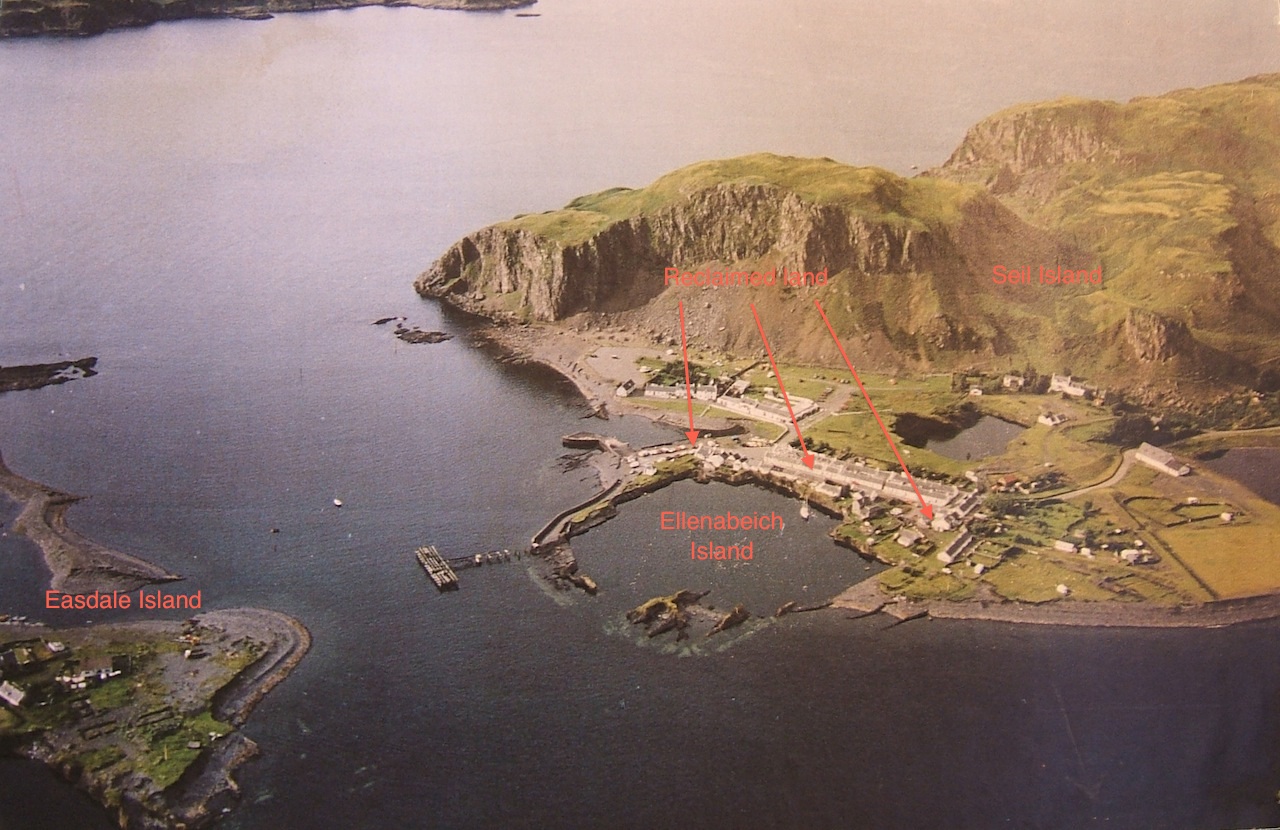
A ferry connects Easdale to the village of Ellenabeich on Seil. That is it in the photo below.
Easdale's main claim to fame now is that it is the home of the World Stone Skimming Championships. The contest is held in one of the quarries. The next world championship is on the 25th September 2011.
Ellenabeich
There used to be an island called Ellanabeich but the entire centre of the island was dug out [Ellanabeich slates were particularly fine] and the spoil from the workings used to connect the island of Ellanabeich to the island of Seil.
The village of Ellanabeich now stands on that landfill.
There are four slate islands; Easdale, Seil, Luing and Belnahau. Around 3,000 people lived on the islands when the quarries were working. All the islands [and their quarries] belonged to the huge Breadalbane estate, owned by the Campbells of Glen Orchy. The Campbells made a lot of money from the slate quarries but not much of it went to the quarry workers. The Campbells used some of the money to build the huge Taymouth Castle.
The Great Storm
At one time over 400 people lived on Easdale until one terrible night in 1881 when a storm and a high tide sent water over the island. Livestock was washed away, gardens destroyed, 40 boats lost and the quarries filled with water. All the mining machinery and the workmen's tools had been in the pits and were now underwater. Mining stopped and the islanders were destitute.
| Two flooded quarries |
| Easdale island in the foreground. The village of Ellanabeich [on Seil] in the background. |
The workers cottages were built of slate. You can see one below. The ships that came to take away the slates carried soil as ballast. This was spread on the island to create gardens where vegetables could be grown to supplement their oats and fish diet.
Some mining continued after the great storm, particularly on the other islands. The photograph below shows some of the slate miners from that period.
By 1930 the demand for slate had shrunk, the Breadalbane estate was bankrupt, people moved away to better paid jobs and slate mining ended. For many years Easdale was almost deserted but now the population has increased to over 60 and new houses are being built. It was a lovely summer day when I visited and the island looked beautiful. From the top of the island's hill there were outstanding views of the Firth of Lorn, the other slate islands and Mull. I would imagine it can be pretty bleak in winter.
| The old and new houses of Easdale |
Easdale's main claim to fame now is that it is the home of the World Stone Skimming Championships. The contest is held in one of the quarries. The next world championship is on the 25th September 2011.
Ellenabeich
There used to be an island called Ellanabeich but the entire centre of the island was dug out [Ellanabeich slates were particularly fine] and the spoil from the workings used to connect the island of Ellanabeich to the island of Seil.
The village of Ellanabeich now stands on that landfill.
Slate Wreck

I was reading this article in Wikipedia about the Welsh slate industry and came upon the following line.
Slate has been mined in north Wales for several centuries — this was recently confirmed by the discovery of the wreck of a wooden ship carrying finished slates in the Menai Strait which dates from the 16th century.
It reminded me of the time I dived a slate wreck in the Sound of Mull, off the west coast of Scotland. The wooden hull of the boat had rotted away, leaving behind its cargo of roof slates. These were neatly stacked up on the seabed. They looked rather strange amongst the rocks and seaweed. I believed at the time that the boat had been transporting a family from one part of Scotland to another, and they had been carrying their roof slates with them as being too valuable to lead behind. The truth turned out to be less interesting.
When I read the Wikipedia article I did a search for slate wreck and Mull, and found this article. Apparently the boat was called the John Preston, and had been carrying a cargo of slates from Wales to Scotland. The boat had gone down in a storm, but the crew of six had managed to scramble ashore.
There are a lot of wrecks around Great Britain. Two world wars, submarine warfare and a lot of bad weather have seen to that. I remember diving a site off the Scilly Isles. It contained three wrecks stacked one on top of the other. They gone down at different times, but the locals had only known about the first and the third. The middle one had gone down in a storm and all the crew had been lost. Nobody had known about the lost ship until divers chanced upon the wreck gully.
One reason there are a lot of wrecks off the Scilly Isles is because the locals used to support themselves by luring ships onto the rocks and then ransacking them.
Bring back the Lynx
Britain has too many deer [about 1.5 million] according to this BBC report. 'There are now more deer in the UK than at any time since the last Ice Age.' They destroy woodland and prevent its regeneration. Anybody who goes around the British countryside can see for themselves how much damage is being done.
It has been suggested that a cull of 50% [750,000 deer] per year is needed to control numbers. The deer would be shot and the meat processed for human consumption.
In the short term shooting is probably the only option. In the longer term we might also reintroduce the Eurasian lynx.
The lynx, which disappeared from the UK around 1,000 years ago, could be reintroduced using animals captured in continental Europe. There are now populations living in Germany, Switzerland, Poland, Slovakia and France. The Eurasian lynx is a large animal and is known to have a taste for deer.
The reintroduction of the lynx to Scotland is supported by numerous conservation groups, including Trees for Life and the Scottish Wildlife Trust. Supporters point to the country's soaring deer population, which could be managed by lynx. It is estimated that just one of the cats would get through 50 to 60 deer a year.
Research carried out in Europe has shown that lynx eat far more foxes than they do ground-nesting birds, which is one of the fears expressed by estate owners and land managers.
'In Scotland we have to manage deer to protect commercial forestry and we have to manage the foxes to protect game birds, so the lynx, as well as bringing in tourists, is a very practical cat to have around.' Link
Lynx are very shy animals so they are rarely seen. They do not attack people. Contrary to the alarmist nonsense of gamekeepers and farmers they are unlikely to attack sheep. They prefer to stay concealed in woods and don't like to go in open fields.
Lynx could only be as partial solution to the deer control problem If each lynx took 60 deer per year it would take a UK population of 12,500 to kill 750,000 deer. Even countries such as Sweden and Finland, which have had lynx for a long time, are not thought to have more than 1500-2000.
Beavers and boars have become re-established in the UK, mainly by accident. There is no reason why the lynx could not return as well. No reason apart from the lack of political will.
It has been suggested that a cull of 50% [750,000 deer] per year is needed to control numbers. The deer would be shot and the meat processed for human consumption.
In the short term shooting is probably the only option. In the longer term we might also reintroduce the Eurasian lynx.
The lynx, which disappeared from the UK around 1,000 years ago, could be reintroduced using animals captured in continental Europe. There are now populations living in Germany, Switzerland, Poland, Slovakia and France. The Eurasian lynx is a large animal and is known to have a taste for deer.
The reintroduction of the lynx to Scotland is supported by numerous conservation groups, including Trees for Life and the Scottish Wildlife Trust. Supporters point to the country's soaring deer population, which could be managed by lynx. It is estimated that just one of the cats would get through 50 to 60 deer a year.
Research carried out in Europe has shown that lynx eat far more foxes than they do ground-nesting birds, which is one of the fears expressed by estate owners and land managers.
'In Scotland we have to manage deer to protect commercial forestry and we have to manage the foxes to protect game birds, so the lynx, as well as bringing in tourists, is a very practical cat to have around.' Link
Lynx are very shy animals so they are rarely seen. They do not attack people. Contrary to the alarmist nonsense of gamekeepers and farmers they are unlikely to attack sheep. They prefer to stay concealed in woods and don't like to go in open fields.
Lynx could only be as partial solution to the deer control problem If each lynx took 60 deer per year it would take a UK population of 12,500 to kill 750,000 deer. Even countries such as Sweden and Finland, which have had lynx for a long time, are not thought to have more than 1500-2000.
Beavers and boars have become re-established in the UK, mainly by accident. There is no reason why the lynx could not return as well. No reason apart from the lack of political will.
Spyware in Firefox?
Is there spyware in the Firefox for Android browser?
I started using Firefox several years ago because it had far better privacy protections than Safari or Internet Explorer. The desktop version still has.
I recently acquired a new Android tablet and went to Google Play [aka Android App Store] to download Firefox.
Link to Firefox on Google Play
To Google's credit they show what permissions an app takes if you install it [Apple do not]. When you look at some of these lists of permissions it is clear that many of the apps in the Play Store are little better than spyware.
I checked Firefox's permissions but I did not expect to find anything untoward.
The apps description emphasises privacy as you can see below.
However, when you look at the detailed list of the permissions the app would take it is clear that it provides anything but privacy.

Particularly alarming was what Firefox wanted to do with my tablet's cameras.
Anybody who installs Firefox gives it permission to take photographs or video [from either camera] whenever it likes. The users permission is not required. Nor are users told when the cameras are operating. Think of the implications of this. Even if users were foolish enough to trust Mozilla [producers of Firefox] what would happen if some malign malware was able to get control of your browser and start the cameras rolling?
How can Mozilla justify including this in Firefox? If it is not spyware it is hard to imagine how else it could be defined. It would be interesting to know what has gone wrong at Mozilla for this to happen.
I didn't download Firefox [though over 200,000 idiots have done]. I took a look at Google's Chrome browser and it does not seem to need to operate my tablet's cameras. These are the permissions it wants. They are not trivial but at least they exclude the permission for rectal probing that Firefox wants
Now that I have seen what Firefox for Android wants I wonder what the desktop versions of Firefox are up to.
I started using Firefox several years ago because it had far better privacy protections than Safari or Internet Explorer. The desktop version still has.
I recently acquired a new Android tablet and went to Google Play [aka Android App Store] to download Firefox.
Link to Firefox on Google Play
To Google's credit they show what permissions an app takes if you install it [Apple do not]. When you look at some of these lists of permissions it is clear that many of the apps in the Play Store are little better than spyware.
I checked Firefox's permissions but I did not expect to find anything untoward.
The apps description emphasises privacy as you can see below.
However, when you look at the detailed list of the permissions the app would take it is clear that it provides anything but privacy.

Particularly alarming was what Firefox wanted to do with my tablet's cameras.
Anybody who installs Firefox gives it permission to take photographs or video [from either camera] whenever it likes. The users permission is not required. Nor are users told when the cameras are operating. Think of the implications of this. Even if users were foolish enough to trust Mozilla [producers of Firefox] what would happen if some malign malware was able to get control of your browser and start the cameras rolling?
How can Mozilla justify including this in Firefox? If it is not spyware it is hard to imagine how else it could be defined. It would be interesting to know what has gone wrong at Mozilla for this to happen.
I didn't download Firefox [though over 200,000 idiots have done]. I took a look at Google's Chrome browser and it does not seem to need to operate my tablet's cameras. These are the permissions it wants. They are not trivial but at least they exclude the permission for rectal probing that Firefox wants
No more Delicious bookmarks
I have been splicing my Delicious bookmarks into this blog's RSS feed but Delicious has stopped working for me [yet again] and I am no longer using it.
In future I will be using Pinboard, a far better bookmarking service. The link is
https://pinboard.in/u:rogerp
The link is also on this blog's home page.
In future I will be using Pinboard, a far better bookmarking service. The link is
https://pinboard.in/u:rogerp
The link is also on this blog's home page.
Amazon v John Lewis
I have just bought a Samsung Galaxy Note tablet to replace my iPad. I had the choice of buying online from Amazon, or either online or offline from John Lewis.
For non UK readers, John Lewis is a highly rated [by consumer groups] chain of department stores. They were a few pounds more expensive than Amazon but I bought offline from them for the following reasons.
John Lewis pays UK tax. Amazon is reportedly dodging paying its fair share by moving its profits offshore. I don't like that.
John Lewis is owned by its employees and is British. Amazon is neither.
Amazon provides good service. John Lewis provides even better. They are well known for their ethical behaviour and the quality of their staff [aka owners]. There is a big difference between the quality of JL staff and those of other retailers. Owning your own business really does make a difference.
Amazon is getting too big. The danger is that they will start to abuse their dominance. We have recently had a spate of bankruptcies by UK High Street retail chains and there are now lots of empty shops.
BTW - My first impression of the Galaxy Note is that it is a cracking piece of kit that shows just how overpriced and outdated the iPad has become.
For non UK readers, John Lewis is a highly rated [by consumer groups] chain of department stores. They were a few pounds more expensive than Amazon but I bought offline from them for the following reasons.
John Lewis pays UK tax. Amazon is reportedly dodging paying its fair share by moving its profits offshore. I don't like that.
John Lewis is owned by its employees and is British. Amazon is neither.
Amazon provides good service. John Lewis provides even better. They are well known for their ethical behaviour and the quality of their staff [aka owners]. There is a big difference between the quality of JL staff and those of other retailers. Owning your own business really does make a difference.
Amazon is getting too big. The danger is that they will start to abuse their dominance. We have recently had a spate of bankruptcies by UK High Street retail chains and there are now lots of empty shops.
BTW - My first impression of the Galaxy Note is that it is a cracking piece of kit that shows just how overpriced and outdated the iPad has become.
Meetings
Pfund's Dairy
Pfund's Dairy is in Dresden, and is one of the city's tourist attractions. The interior of the shop is beautifully tiled. The ceiling tiles are particularly good. The dairy was set up in the 19th century by Paul Pfund, who built a huge dairy business in the city. The shop is now said to be in the Guinness Book of Records as the 'most beautiful dairy in the world'.
Paul’s descendants have a nice little living off the tourist business because he spent a bit more effort doing something right.


Paul’s descendants have a nice little living off the tourist business because he spent a bit more effort doing something right.


Stop Engines

The bridge of a Japanese freighter sunk in Truk [Chuuk] Lagoon in 1944 during Operation Hailstorm. The flecks in the water are small fish. There were a lot of unexploded WW2 munitions on this ship.
Assad's trump card
We are told that the people who attacked the gas installation in Algeria and the rebels in Mali used weapons looted from weapons depots in Libya when the Gaddafi regime was overthrown. I suspect there might be similar attacks in the future.
When I read about this unanticipated consequence it occurred to me that Assad's regime might hold a powerful trump card in the form of its own weapons stores.
America's proxies in the Middle East are funding and arming the people who are trying to overthrow the Assad's government. America in turn is acting at the instigation of the Israeli government. Why is it Israel who is behind all this? Well, apply the lawyers test of Cui Bono [To whose benefit]. If you want to know who is really behind some event look at who stands to benefit the most from the event. If Assad is deposed Iran loses its key ally and is also prevented from shipping arms through Iraq and Syria to Hamas. That's a big win for Israel but I cannot see who else gains. The West stands to gain nothing but lose a lot.
During the US election campaign Obama kept the Jewish lobby groups on his side by splashing a little petrol on the Syrian flames but now he is elected that motive has gone and he might be inclined to pull the plug on the Syrian insurgent groups. Especially if Assad plays his trump card.
That card is the regimes stock of chemical weapons and ground to air missiles. What would happen if Syria told the US that unless they helped end the insurgency some of the more extreme groups who are involved in the fighting might just capture a store containing weapons the West is desperate to keep out of the hands of terrorists? What if the unanticipated consequence of removing Assad's regime might be a chemical weapon turning up in an American city or a ground to air missile bringing down an airliner?
Even if the Syrian government does not actually play that card it seems very likely that, in the chaos following a insurgent victory, some weapons of mass destruction will get into dangerous hands.
I would have thought the events in Iraq and Libya might have been enough warning enough of the dangers of regime change. Lets hope that America does not need another lesson.
When I read about this unanticipated consequence it occurred to me that Assad's regime might hold a powerful trump card in the form of its own weapons stores.
America's proxies in the Middle East are funding and arming the people who are trying to overthrow the Assad's government. America in turn is acting at the instigation of the Israeli government. Why is it Israel who is behind all this? Well, apply the lawyers test of Cui Bono [To whose benefit]. If you want to know who is really behind some event look at who stands to benefit the most from the event. If Assad is deposed Iran loses its key ally and is also prevented from shipping arms through Iraq and Syria to Hamas. That's a big win for Israel but I cannot see who else gains. The West stands to gain nothing but lose a lot.
During the US election campaign Obama kept the Jewish lobby groups on his side by splashing a little petrol on the Syrian flames but now he is elected that motive has gone and he might be inclined to pull the plug on the Syrian insurgent groups. Especially if Assad plays his trump card.
That card is the regimes stock of chemical weapons and ground to air missiles. What would happen if Syria told the US that unless they helped end the insurgency some of the more extreme groups who are involved in the fighting might just capture a store containing weapons the West is desperate to keep out of the hands of terrorists? What if the unanticipated consequence of removing Assad's regime might be a chemical weapon turning up in an American city or a ground to air missile bringing down an airliner?
Even if the Syrian government does not actually play that card it seems very likely that, in the chaos following a insurgent victory, some weapons of mass destruction will get into dangerous hands.
I would have thought the events in Iraq and Libya might have been enough warning enough of the dangers of regime change. Lets hope that America does not need another lesson.
Subscribe to:
Posts (Atom)